Selecting the correct load capacity for a universal testing machine (UTM) is one of the most important decisions when configuring a tensile testing system for metals. A machine that is undersized cannot complete the test, while an oversized system increases cost, footprint, and may reduce resolution at lower load levels.
This guide compares 100 kN, 300 kN and 600 kN universal testing machines for tensile testing of metal bars, sheets and wires, and explains how to match capacity to material strength, sample form and production requirements.
Tensile testing measures the force required to pull a metal specimen to failure and derives properties such as yield strength, ultimate tensile strength, elongation and reduction of area. The required machine capacity depends on two basic factors:
Important: Machine capacity should be selected so that expected maximum test force falls roughly between 20% and 80% of the full-scale load range. This ensures good measurement accuracy while leaving a safety margin for material variation and unexpected higher strength values.
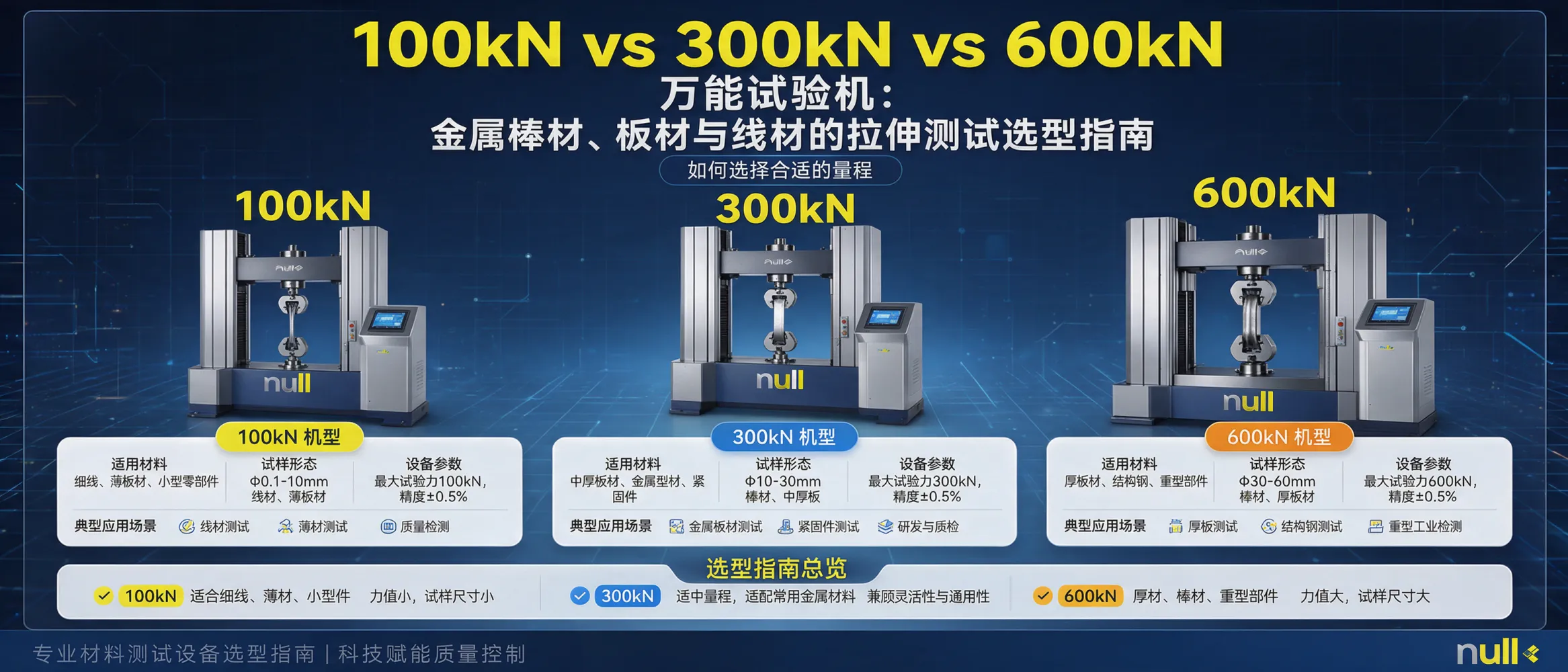
The following table summarizes the typical use cases for three common UTM capacities in metal tensile testing. Actual suitability must always be verified against specific sample dimensions and material strength levels.
| Machine Capacity | Typical Metal Sample Forms | Common Material Examples | Typical Use Scenarios |
|---|---|---|---|
| 100 kN | Thin sheets, small-diameter wires, thin round bars, small flat specimens | Aluminum alloys, copper, brass, mild steel sheet, fine wire products | R&D laboratories, wire production QC, thin-gauge stamping materials, light-component testing |
| 300 kN | Medium bars, standard flat tensile specimens, thicker sheets, medium wires | Carbon steel, alloy steel, stainless steel, structural sections, forged parts | General metal manufacturing QC, heat treatment verification, machinery parts, standard steel product testing |
| 600 kN | Large-diameter bars, thick plates, heavy section specimens, full-size fasteners | High-strength steel, thick-walled tubes, bridge components, large bolts, heavy forgings | Steel mills, heavy industry, aerospace-grade alloys, large structural component testing, high-tensile fastener certification |
Rather than choosing by model name alone, it is recommended to work backwards from your actual sample and test requirements.
Specify whether you will test round bars, flat sheets, wires, tubular products or machined standard specimens. Record the original cross-sectional area of the sample, since this directly determines the required tensile load.
Identify the minimum and maximum tensile strength values expected for the materials you test. For quality control purposes, consider both the nominal specification and the upper tolerance of material strength.
The approximate maximum load can be estimated using:
Maximum test force (kN) ≈ Tensile strength (MPa) × Cross-sectional area (mm²) ÷ 1000
Add a safety margin of approximately 20% to 30% above the calculated maximum load to cover material variation, unexpected higher strength batches, and future testing needs.
Capacity alone is not enough. Also confirm requirements related to:
Choosing a machine that cannot reach the maximum failure load of high-strength or large-section samples means tests cannot be completed. It also risks overloading and damaging the load cell or frame.
Selecting a 600 kN machine only to test small, low-strength wires or thin sheets can reduce relative load measurement accuracy at low forces and increases equipment cost, floor space and installation requirements.
Practical recommendation: If your testing covers a very wide range of sample sizes and strengths, consider whether a single mid-range UTM is sufficient, or whether two machines with different capacity levels – for example a 100 kN and a 300 kN system – will give better overall accuracy and utilization.
The right universal testing machine should be selected not only by kN rating, but also by the complete system configuration including grips, fixtures, extensometer, software and compliance with relevant test standards.
Before finalizing equipment selection, it is advisable to provide your supplier with representative sample dimensions, material strength ranges, required test standards and daily testing volume so that the machine capacity, frame stiffness and accessories can be properly matched.
Sinowon provides a range of universal testing machines and related material testing solutions, with configurations tailored to metal bar, sheet and wire tensile testing as well as other common mechanical property tests. For capacity selection support based on your specific samples, you may consult with our technical team to verify the most suitable system configuration.