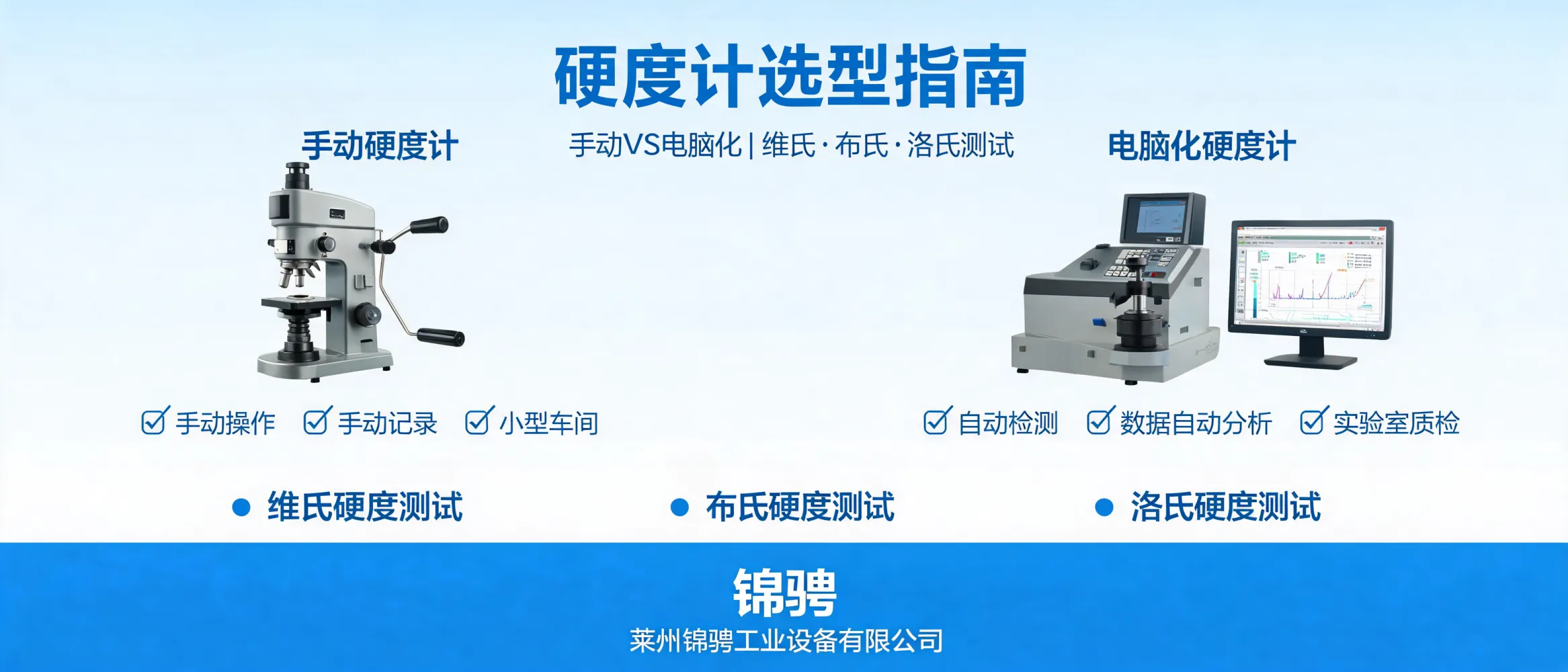
Choosing a hardness tester is not only about “which model to buy”—it is about matching a test method (Vickers/Brinell/Rockwell) and an operation mode (manual vs computerized) to your materials, accuracy expectations, test volume, and reporting workflow.
This guide is prepared by Laizhou Jincheng Industrial Equipment Co.,Ltd (Laizhou Jincheng), a B2B supplier focused on hardness testing and metallographic inspection equipment since 2004, serving manufacturing QC, universities, and research laboratories.
Both manual and computerized hardness testers rely on the same indentation principles. The difference is how much the instrument assists with loading control, measurement, calculation, and record keeping. Your decision should be driven by test frequency, operator consistency needs, and documentation requirements.
| Selection factor | Manual hardness tester | Computerized hardness tester |
|---|---|---|
| Typical use | Routine checks, on-site/near-line testing, teaching labs, low-to-mid volume. | QC laboratories, higher volume testing, standardized reporting, multi-operator environments. |
| Operation | Direct, intuitive controls; relies more on operator technique and reading. | Assisted workflows with sensors/software for measurement and calculation; reduces manual steps. |
| Consistency | Good when operated by trained users, but variation can increase across shifts/operators. | Better fit when you need stable, repeatable procedures and comparable results across users. |
| Throughput | Efficient for occasional tests; may slow down for large batches due to manual reading and recording. | Higher throughput potential with faster measurement, automatic calculation, and batch-style reporting. |
| Data & reporting | Manual recording; suitable when documentation is simple. | Built for traceable records; supports structured output and statistical handling for QC decision-making. |
Practical rule: If your priority is quick checks with simple documentation, start with manual. If you need consistent workflows, frequent testing, and organized data for QC audits or lab reporting, consider a computerized hardness tester.
Method selection should be based on material type, surface condition, indent size / sample thickness, and how fine a result you need to interpret. In many companies, more than one method is used across different components and stages.
Note on standards: In hardness testing, method choice and procedure should follow your internal QC specs and the relevant international standards (commonly ASTM/ISO) applicable to your material and industry requirements.
To shorten selection time and avoid mismatched configurations, prepare the information below before requesting a quotation or technical recommendation.
If you also perform metallographic inspection, aligning hardness testing with your sample preparation and inspection workflow can improve overall QC efficiency. Laizhou Jincheng supplies both hardness testing and metallographic equipment to support a complete materials testing setup.
As a manufacturer focused on hardness testing and metallographic inspection equipment, Laizhou Jincheng Industrial Equipment Co.,Ltd works with B2B buyers to clarify selection boundaries and configuration details, including manual vs computerized operation and method fit for Vickers/Brinell/Rockwell.
We focus on matching the tester to your sample type, test frequency, and reporting expectations—so your procurement decision is based on workflow requirements rather than model names.
We serve customers in manufacturing, universities, and research labs, with experience supporting overseas markets including Russia, Southeast Asia, and Europe.
To get a precise recommendation: share your material type, preferred method (HV/HB/HR), part thickness/geometry, expected daily test volume, and whether you require computerized data processing and statistical reports.
Proper selection helps you build a stable hardness testing process that fits your QC or lab workflow. When you are ready, Laizhou Jincheng can review your requirements and help narrow down the right approach—manual or computerized—and the most suitable Vickers/Brinell/Rockwell method for your samples.

Hardness-TesterHVS-5103050A-7.jpg?x-oss-process=image/resize,m_fill,h_600,w_600/format,webp)