When building or upgrading a material testing laboratory, one of the most common decisions is whether to start with a basic manual metallographic sample preparation setup or invest in an automated metallographic sample preparation system. The right choice depends not only on budget, but also on daily sample volume, staff experience, quality consistency requirements, and long-term lab development plans.
This comparison covers cost structure, preparation efficiency, staffing needs, result consistency, and typical application scenarios, helping lab managers and procurement teams evaluate which configuration better matches their current and future metallography workflow.
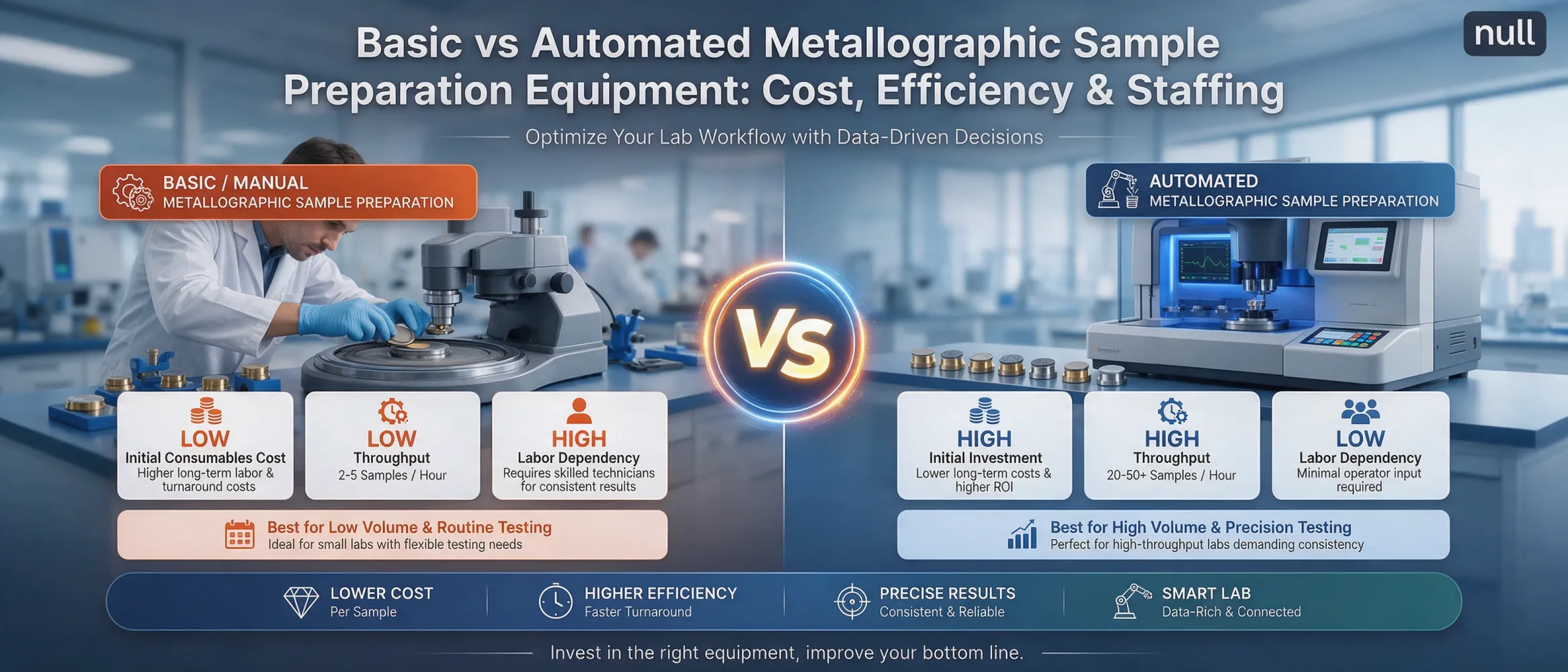
A basic or entry-level metallographic sample preparation configuration typically relies on manually operated equipment that allows operators to perform the main steps of specimen preparation, including cutting, mounting, grinding, and polishing.
This type of configuration is highly flexible and requires relatively low initial investment. Operators can adjust pressure, direction, and process duration according to different materials and sample shapes. However, final preparation quality depends heavily on operator skill and experience.
An automated metallographic sample preparation system uses programmable equipment to reduce manual intervention in key preparation steps, especially in grinding and polishing. Advanced configurations may also include automated cutting, automated mounting, or integrated specimen handling systems.
The core value of automation lies in repeatability. Once a preparation recipe is verified, the same parameters can be reproduced across shifts, operators, and sample batches, which is especially important for quality control laboratories that need consistent and traceable results.
The table below compares the two configurations from six key dimensions commonly considered during metallography lab setup.
| Comparison Item | Basic Manual Setup | Automated Preparation System |
|---|---|---|
| Initial cost investment | Lower entry cost; suitable for labs with limited initial budget | Higher initial investment; includes hardware, software programming, and installation |
| Sample preparation efficiency | Lower throughput per operator; time increases with sample quantity | Higher throughput, especially for batch specimens; reduces manual waiting time |
| Personnel requirement | Requires experienced operators; quality depends on individual skill | Requires training for recipe setup and maintenance; less operator dependence during routine work |
| Result consistency | More variation between operators or shifts; higher risk of human error | High repeatability with stored recipes; stable quality across batches |
| Flexibility for special samples | High flexibility; easy to adjust for irregular shapes or sensitive materials | Requires recipe development; more suitable for standard specimen types and sizes |
| Suitable sample volume | Low to medium volume, R&D labs, or pilot testing environments | Medium to high volume, quality control labs, and multi-user facilities |
There is no universally better option. The appropriate configuration should be determined based on actual testing conditions and long-term planning.
Practical suggestion: For laboratories that are uncertain about future workload, a phased approach is often a balanced choice. Start with reliable basic equipment and clear process specifications, then upgrade to automated preparation modules when sample volume, quality requirements, or staffing changes justify the investment.
Whether basic or automated, final metallographic preparation quality is also affected by other factors that should not be ignored during lab planning:
Selecting between basic and automated metallographic sample preparation equipment is essentially a balance between cost, efficiency, consistency, and staff capability. A decision based on real sample volume, material types, and quality objectives will be more sustainable than a choice driven only by initial price or maximum automation level.
By clearly defining daily testing tasks, required standards, and long-term development plans, laboratories can build a metallographic sample preparation line that matches their actual needs and supports reliable microscopic analysis and material evaluation.







Hardness-TesterHV-1000-1.jpg?x-oss-process=image/resize,h_1200,m_lfit/format,webp)