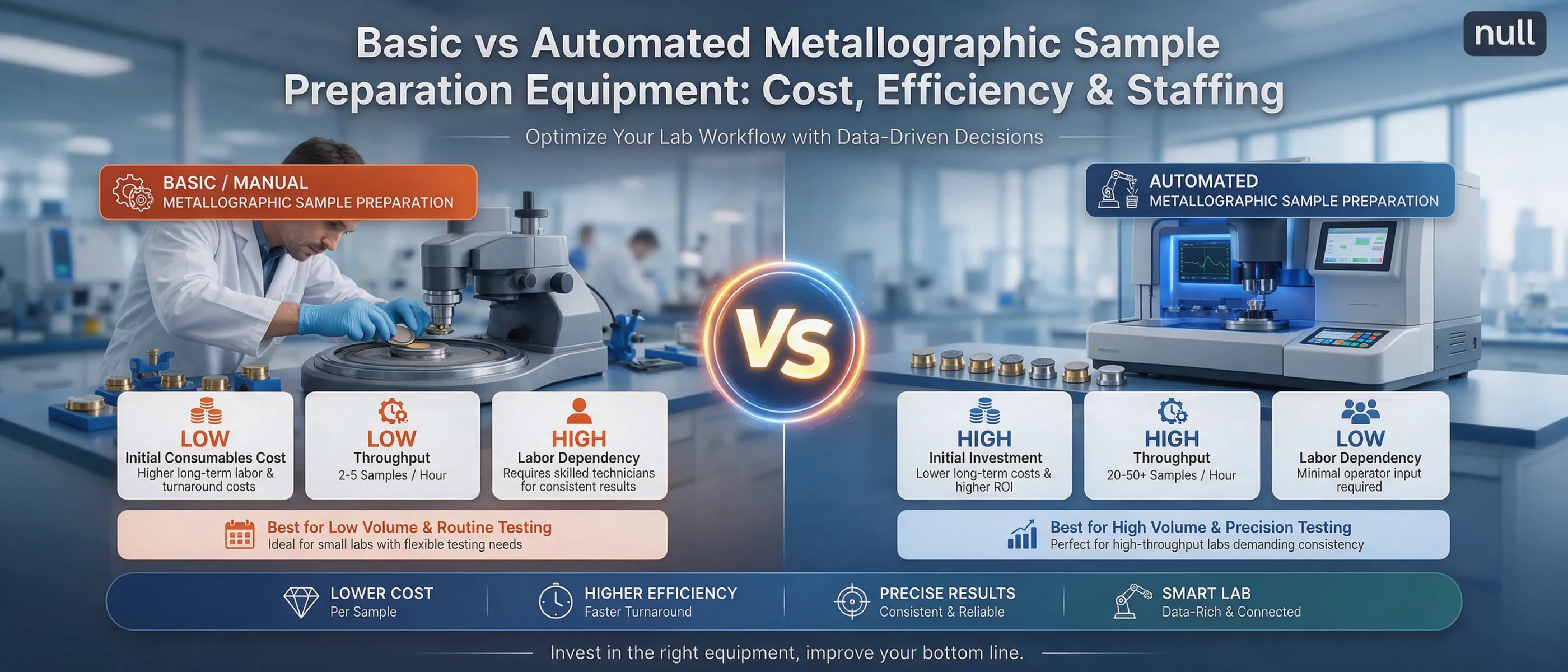
Choosing metallographic sample preparation equipment is less about “manual vs computerized” as a label, and more about matching your throughput, repeatability requirements, operator skill level, and budget to the right workflow. As a manufacturer focused on metallographic and hardness testing since 2004, Laizhou Jincheng Industrial Equipment Co.,Ltd (Laizhou Jincheng) supports users in mechanical manufacturing, metallurgy, universities, and research labs with complete equipment-and-consumables solutions—ranging from intuitive manual preparation to automated, computerized systems aligned with ASTM and ISO practices.
Quick takeaway: Manual preparation is often best for teaching, low volume, and flexible trial work. Computerized preparation is usually best for higher efficiency, stronger consistency, and standardized QC routines.
A complete metallographic preparation line generally covers multiple steps. The exact configuration depends on material type, sample size/shape, target surface quality, and the inspection method (optical microscopy, image analysis, etc.).
| Decision factor | Manual preparation | Computerized preparation |
|---|---|---|
| Operating efficiency | Suitable for low-to-medium volume; operator time is a key variable. | Higher throughput potential via automation and program control (especially for repetitive routines). |
| Consistency / repeatability | More dependent on operator technique and experience; good for exploratory work. | Better for standardized outcomes through controlled parameters and repeatable programs. |
| Learning & training | Intuitive to demonstrate fundamentals; strong fit for teaching labs. | Requires parameter setup discipline; training focuses on program design and process control. |
| Application scenarios | Teaching, prototyping, small-batch research, varied sample types. | Production QC, routine testing, multi-operator environments, higher standardization needs. |
| Budget & long-term cost | Lower initial investment; cost relies more on labor and skill availability. | Higher initial investment; can reduce rework and stabilize results for standardized operations. |
Selection tip: If your lab often re-prepares samples due to inconsistent surfaces, a more controlled (computerized) workflow can be a practical upgrade. If your work involves frequent method changes across materials, manual flexibility may be more valuable.
Preparation determines whether microstructure is truly “revealed” or distorted by scratches, deformation, or unevenness. For users who need clear observation and faster documentation, an optical system with stable imaging and analysis tools can streamline the step from “prepared sample” to “interpretable results.”
The 4XC-W from Laizhou Jincheng is designed for metallographic structure analysis with a focus on clear imaging and practical operation.
Best fit: labs that need reliable image clarity for routine microstructure observation, documentation, and software-assisted analysis.
Tip: When upgrading from manual to computerized preparation, pairing it with a consistent imaging setup helps standardize your “prep → observe → report” pipeline.
Teaching labs: manual preparation for hands-on fundamentals; add imaging when documentation is required.
Manufacturing QC: computerized preparation for repeatability; stable microscopy + software for efficient reporting.
R&D: mixed workflow—manual flexibility for method development, then computerized programs for repeated trials.
Beyond equipment selection, successful metallographic workflows depend on correct configuration, operator onboarding, and long-term support. Laizhou Jincheng provides pre-sales consultation, technical support, repair services, and after-sales保障 to help users keep preparation and analysis running reliably.
With these inputs, we can help match a manual or computerized metallographic sample preparation solution and, where needed, recommend an imaging and analysis configuration such as the 4XC-W inverted metallographic microscope.


Hardness-TesterHVS-5103050-1.jpg?x-oss-process=image/resize,m_fill,h_600,w_600/format,webp)