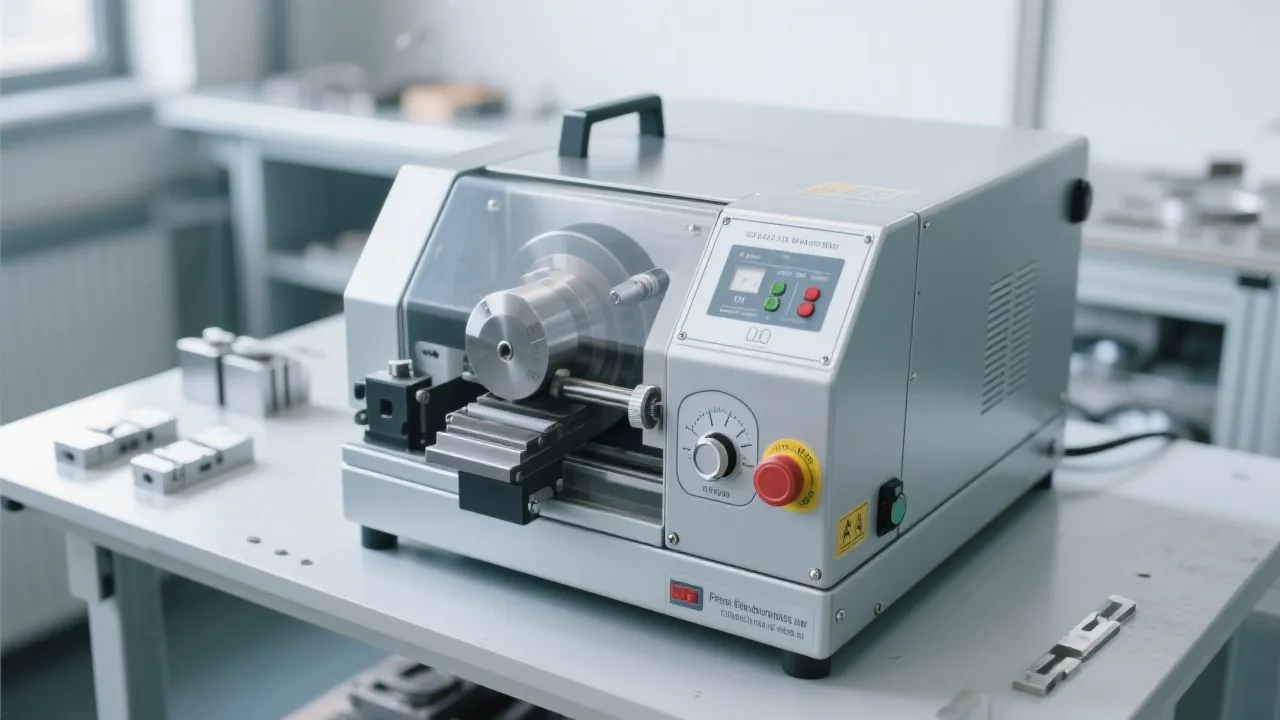
Field tutorial for metal hardness inspection teams · Portable Brinell hardness testing · Brand: 锦骋
Portable Brinell Hardness Tester: Full Operating Workflow to Keep On‑Site Results Accurate and Trustworthy
In real factories, shipyards, steel stockyards, and heavy-equipment maintenance bays, a portable Brinell hardness test often happens under pressure—tight schedules, awkward surfaces, and mixed materials. The difference between “a number” and an actionable measurement usually comes down to process discipline: correct indenter ball selection, stable loading, calibration habits, and clean data reading.
Why this workflow matters (and how errors actually happen)
In Brinell testing, the hardness value is derived from the indentation diameter. That means small practical issues—surface scale, slight rocking, inconsistent dwell time, poor lighting when reading, or a worn ball—can cause measurable drift. In field conditions, experienced inspectors often see repeatability shift by ±3% to ±8% when procedures are not standardized, especially on large weldments or curved parts.
1) Pre‑check: Setup, safety, and “ready-to-measure” conditions
A portable Brinell hardness tester should be treated like a precision instrument—even if it is built for rugged environments. Before any indentation is made, the operator should confirm three things: stability, surface suitability, and traceability.
Stability checklist
- Confirm the frame sits flat; eliminate rocking with proper support blocks.
- Ensure the test point is not on an edge, corner, or thin rib (risk of bulging).
- Keep the contact faces clean; even small debris can tilt the load axis.
Surface suitability
- Remove rust/scale/paint; a light grind is often enough for stable reading.
- Prefer a smooth, matte finish over glossy surfaces to reduce reading errors.
- If the part is curved, use appropriate fixtures to keep loading perpendicular.
Traceability basics
- Record tester ID, indenter ball size, force setting, and dwell time.
- Log material grade/heat number and surface prep method (quick note is enough).
- Plan at least 3 indents per location for field repeatability checks.

2) Choosing the right indenter ball (and why it changes your result)
Indenter ball choice is not a minor detail. It drives indentation geometry and reading sensitivity. In on-site workflows, a practical rule is to match ball size and force so the indentation is clear, measurable, and not overly deep.
| Field scenario | Recommended approach (practical) | Why it helps |
|---|---|---|
| Large forged or cast steel parts | Use a larger ball / stable higher load when allowed | Reduces sensitivity to local grain effects; improves consistency |
| Heat-treated surfaces with higher hardness | Prefer harder ball material; check for ball wear more frequently | Prevents flattening that can bias indentation diameter |
| Thin sections or near weld toes | Avoid edges; reduce load where needed; increase number of repeats | Minimizes bulging and structural influence on the indent |
A common field habit from experienced inspectors: when readings look “too scattered,” they first suspect surface prep, then stability, and only then the instrument. In practice, these three explain most abnormal dispersion.
3) Indenter ball replacement: a clean, controlled routine
Portable Brinell work exposes the indenter assembly to dust, oil mist, abrasive scale, and occasional accidental side loads. A disciplined replacement routine reduces both measurement drift and avoidable downtime.
Recommended replacement triggers (field reality)
- Visible flat spot, scratch, or contamination that cannot be cleaned.
- Sudden repeatability loss after the surface and setup have been verified.
- After high-volume shifts: many teams schedule a check every 300–500 indents, depending on material hardness and cleanliness.
Replacement discipline that protects accuracy
- Keep parts on a clean cloth; avoid placing the ball on metal benches.
- Do not overtighten; torque should be firm but controlled to avoid seat damage.
- After replacement, run a quick verification on a reference block before production checks.

4) Loading control: speed, dwell time, and what operators should standardize
For on-site Brinell testing, consistency beats “hero technique.” A stable loading rate and consistent dwell time reduce operator-to-operator variation. Many quality teams standardize dwell time in the 10–15 s range for steel in field checks (unless an internal procedure or standard requires otherwise), then keep it constant across the whole job.
5) Gauge calibration & verification: keeping your numbers defensible
In B2B environments, “accurate” also means auditable. Calibration is the formal check (often scheduled), while verification is the day-to-day confidence step operators use to avoid surprises in the field.
Verification rhythm (practical)
- Start of shift: verify on a reference block near your expected hardness range.
- After ball replacement: verify again before continuing production checks.
- After transport/impact: verify before any critical acceptance decision.
Documentation that buyers trust
- Record reference block ID and measured values (not just “pass”).
- Keep calibration certificates accessible for audits and customer reviews.
- Note ambient conditions if working outdoors (temperature swings can matter).
Teams using 锦骋 portable Brinell systems often build a lightweight “verification log” into their daily checklist. In supplier audits, that single page can do more to build confidence than a long explanation after the fact.

6) Reading & recording results: how to avoid the “good indent, wrong number” trap
In the field, misreads usually come from glare, poor contrast, and rushing. The operator should ensure the indentation edge is clearly visible and read the diameter consistently (using the same method every time). If readings are borderline or hard to see, it is faster to re-prepare the surface and re-test than to debate questionable data later.
Data recording best practices (site-proven)
- Record location sketches or photos (even simple reference points help re-test later).
- Use consistent averaging rules (e.g., average of 3 indents, reject one outlier only with a stated reason).
- Include the full test condition line: ball size + load + dwell time + material + surface prep.
7) Maintenance that preserves accuracy (not just appearance)
Portable instruments fail quietly: small contamination in load paths, minor seat wear, or loose fixtures can slowly degrade repeatability. A short routine prevents “mystery drift.”
Weekly (or every project)
- Clean force-contact surfaces; remove metal dust and oil films.
- Check fixtures and fasteners for loosening after transport.
- Inspect the indenter ball under good light; replace if uncertain.
Monthly (or high-usage)
- Run verification across two different reference blocks (near low and high range).
- Inspect cables/connectors and seals; field dust ingress is a common cause of issues.
- Review your logs: recurring outliers often point to a repeatable setup mistake.
8) Quick troubleshooting: symptoms → likely causes → actions
| Symptom | Most common cause | First action that usually works |
|---|---|---|
| Readings scattered across repeats | Surface not uniform; tester rocking; ball wear | Re-prepare surface, stabilize support, verify with reference block |
| Indentation edge hard to see | Glare, rough finish, contamination | Lightly polish area, improve lighting angle, clean reading optics |
| Consistent bias vs. known reference | Wrong setup parameters; calibration drift | Re-check ball/load/dwell, then perform full verification or service calibration |
| Unexpected “too soft” results near weld | Testing too close to heat-affected gradients; thin section influence | Move location, increase spacing, repeat across a mapped line |
FAQ (from real on-site inspection conversations)
How many indents should be taken per part in field inspection?
For routine checks, many teams use 3 indents per location and average them. For heterogeneous materials (castings, weld zones, large forgings), it is common to increase to 5–7 indents or to map a short line to capture gradients.
What’s the fastest way to improve repeatability without changing equipment?
Standardize surface preparation, keep the load axis perpendicular with stable supports, and verify on a reference block at the start of the job. In many field cases, these steps reduce variance more than any “advanced” technique.
When should the tester be sent for service or calibration?
If verification results repeatedly fail across clean setups, or after an impact/drop, the safest approach is service inspection. Most companies schedule formal calibration on a fixed cycle (often 12 months), but high-usage sites may shorten it based on internal quality requirements.
How do buyers evaluate a portable Brinell system for on-site work?
Beyond the instrument itself, they look for a complete field workflow: clear operating instructions, easy indenter ball replacement, availability of reference blocks/accessories, and responsive after-sales support for troubleshooting and verification guidance.
A practical note on after-sales support (what makes field teams confident)
For portable Brinell hardness testing, support is not a “nice-to-have.” Field teams value fast answers on setup, verification, spare parts, and calibration scheduling—because inspection decisions affect acceptance, rework, and delivery. 锦骋 users typically prioritize a partner who can provide application guidance, maintenance reminders, and troubleshooting pathways that match real on-site conditions.
Get a Field-Ready Workflow + Tooling Checklist for a Portable Brinell Hardness Tester
Request application guidance, recommended indenter ball selection, verification routine, and maintenance tips tailored to your materials and on-site constraints—so your results stay consistent, defensible, and easy to audit.
Explore portable Brinell hardness tester support from 锦骋 →
Hardness-TesterHV-1000A-1.jpg?x-oss-process=image/resize,m_fill,h_600,w_600/format,webp)