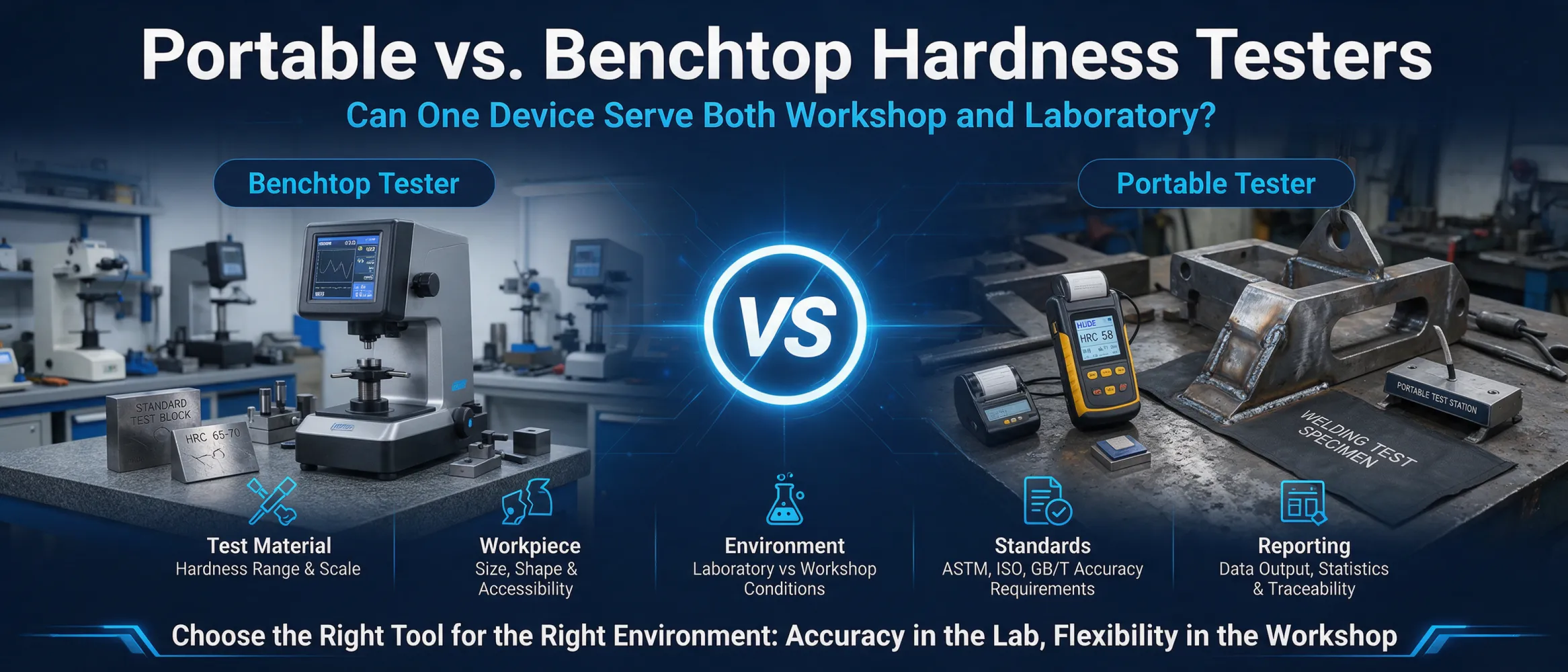
A portable hardness tester can serve both workshop and laboratory needs when its test method, applicable standard and device specifications meet the requirements of every intended application. If the laboratory requires a method, specimen condition or reporting capability that the portable device cannot provide, a separate benchtop tester may be necessary.
Workshop and laboratory testing may involve the same material but different workpieces, acceptance criteria or documentation. Before deciding whether one instrument is sufficient, define the requirements for each setting:
| Consideration | Portable tester | Benchtop tester |
|---|---|---|
| Workpiece access | Can be useful when a component is difficult to move to a laboratory. | Requires a specimen or workpiece that can be positioned and supported on the instrument. |
| Test conditions | Suitability depends on the method, probe access, surface preparation and workpiece support. | A controlled setup can support laboratory testing, provided the specimen and method meet the applicable requirements. |
| Methods and output | Available methods, scales and data functions vary by model. | Available methods, scales, automation and data functions also vary by model. |
Portability alone does not establish whether an instrument is suitable for a laboratory test. Likewise, a benchtop instrument is not automatically appropriate for every material or specimen.
A shared portable tester is worth considering when both locations can use the same permitted method and the intended workpieces meet its test conditions. Check that:
Confirm these points against the applicable standard and the formal technical documentation for the specific instrument before making a purchasing decision.
Consider dedicated laboratory equipment when the required laboratory method or scale is unavailable on the portable device, when a specimen cannot meet the portable method’s requirements, or when the laboratory needs measurement or reporting functions the portable model does not offer. Testing volume and the need to share one instrument between locations can also affect the decision.
For example, a portable method may be useful for an accessible area of a large component, while a prepared small specimen may require a different laboratory method. The decision depends on the actual test requirements, not on the location alone.
Portable and benchtop instruments may use different test principles. Results expressed on different hardness scales should not be treated as directly equivalent without an appropriate conversion basis. Where conversion is permitted, use the applicable standard or validated procedure for the material and state when a result has been converted. A converted value does not automatically replace a test performed using the specified method.
Use the relevant model’s technical documentation and the applicable version of each standard to verify the final configuration and testing procedure.